According to a recent report by Handelsblatt citing a new study from McKinsey, China's latest export restrictions on rare earth elements could put as many as 4 million jobs in Germany—both directly and indirectly—at risk. The potential disruption, driven by a supply cutoff of critical minerals, threatens an estimated €370 billion in industrial output, or about 9% of Germany's GDP.
The report highlights that Germany's automotive, renewable energy, semiconductor, machinery, and aerospace industries all rely heavily on rare earth materials. Roughly 1 million German workers are directly employed in sectors dependent on rare earths, supporting another 3 million indirectly. Together, these industries generate around €150 billion annually in value added to the German economy.
Cornelius Bähr from the German Economic Institute (IW) called McKinsey's assessment "reasonable," adding that earlier IW research estimated around 1.3 million German workers are engaged in manufacturing products containing rare-earth components. "A supply disruption would have a major employment impact," Bähr warned.
Christian Hoffmann, a partner at McKinsey's German office, told Handelsblatt that industrial concerns are shifting from price volatility to the security of raw material supply. He pointed to germanium—used in fiber optics, semiconductors, and military equipment—as a recent example. After China halted germanium exports to the U.S. and sharply reduced shipments to the EU last year, Europe's imports plunged nearly 60% in the first half of 2024. "At first, European firms underestimated the risk," said Hoffmann. "Now, the market is in panic."
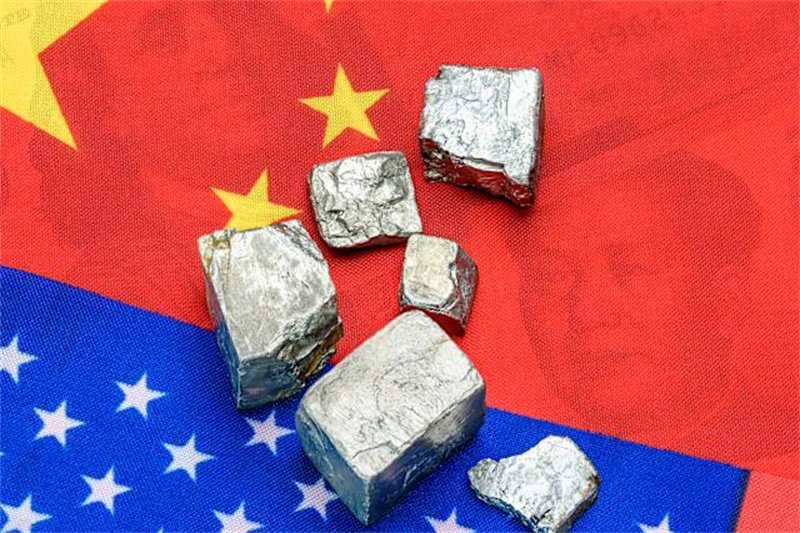
Although Germany has launched multiple initiatives in recent years to secure raw material supplies, Hoffmann noted that "once markets stabilize temporarily, the policies are often shelved." He praised the federal government's Raw Materials Fund (Rohstoff-Fonds)—a program run by state-owned development bank KfW that supports companies exploring new non-Chinese sources of critical minerals. The fund provides guarantees to lower investment risks and bridge cost gaps to offset China's pricing advantage.
Hoffmann also urged cross-industry cooperation among manufacturers, mining firms, academia, banks, and private equity to establish a more resilient supply chain—from extraction to processing and storage—and even form joint procurement alliances to strengthen Germany's bargaining position in global raw material markets.

Taiwan Says Semiconductor Sector Unaffected
Taiwan's Ministry of Economic Affairs said the island's semiconductor industry will not be significantly affected by China's newly expanded export controls on rare earths, according to a statement released over the weekend.
The ministry clarified that the rare-earth elements covered by Beijing's latest restrictions—holmium, erbium, thulium, europium, and ytterbium—are not used in semiconductor manufacturing. Taiwan, home to global foundry leader TSMC, sources most of its necessary rare-earth derivatives from Europe, the United States, and Japan.
China announced the expanded restrictions on October 9, citing national security concerns and the risk of "military misuse" amid ongoing geopolitical tensions. The new rules not only add more rare-earth elements to the export licensing list but also extend to derivative materials, processing technologies, and documentation—potentially complicating international trade in advanced electronics, electric vehicles, and defense systems.
While Taiwan's fabs remain largely insulated, analysts caution that the broader electronics ecosystem, including components such as hard drives and high-performance magnets, could eventually feel the pressure. These parts rely on heavy rare-earth dopants for stability and magnetic strength—materials increasingly under Beijing's control.
For now, Taiwan's government says chip production remains stable, but both European and Asian manufacturers are bracing for further supply chain disruptions as China continues to tighten its grip on critical raw materials.
+86 191 9627 2716
+86 181 7379 0595
8:30 a.m. to 5:30 p.m., Monday to Friday


